Tesamorelin and retatrutide: fat, weight and glucose
The useful comparison begins with the outcome being measured. Different populations and units make a single winner hard to defend.
Tesamorelin vs retatrutide by outcome
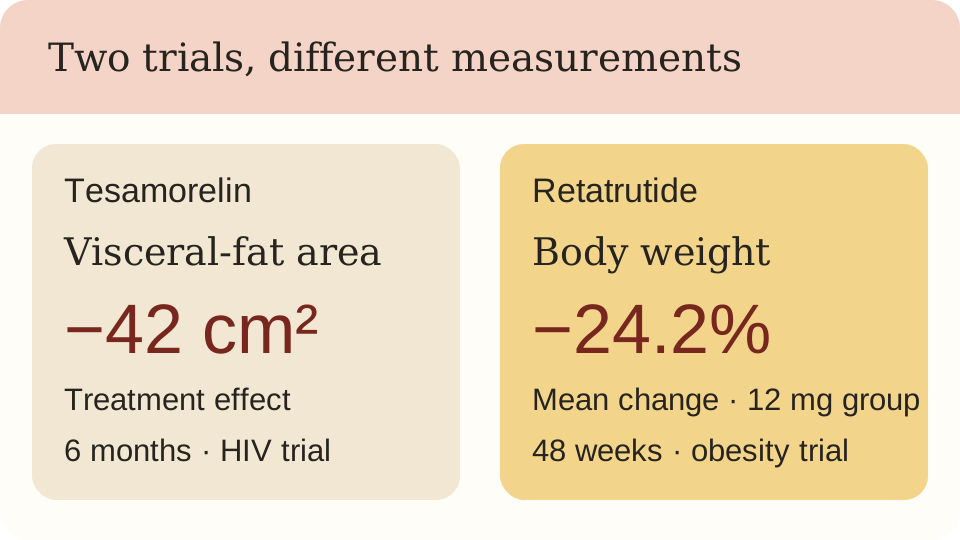
A contest over fat loss was my starting assumption. The trials pull it apart into more useful questions: where the fat was measured, what changed in body weight, and how glucose responded. Tesamorelin and retatrutide have separate clinical records, with no head-to-head trial in the sources collected here.
| Outcome | Tesamorelin | Retatrutide |
|---|---|---|
| Visceral fat | Treatment effect -42 cm2 at six months in a trial of 50 antiretroviral-treated adults with HIV | The cited obesity trial reports total weight; the liver substudy reports liver fat |
| Liver fat | Net hepatic lipid-to-water change -2.9% at six months in that HIV trial | Relative liver-fat change -82.4% at 24 weeks in the 12 mg group of the MASLD substudy |
| Body weight | The pivotal evidence focuses on HIV-associated abdominal fat accumulation | Mean body-weight change -24.2% versus -2.1% with placebo at 48 weeks in the 12 mg obesity-trial group |
| Glucose | No significant change in fasting glucose or insulin sensitivity over two weeks in 13 healthy men | HbA1c reduction of 2.02 percentage points at 24 weeks in the 12 mg group of the type 2 diabetes trial |
The liver studies differ in both population and measurement. Ranking their percentages as if they came from one experiment would answer a question neither trial asked.
Receptors and trial participants
Tesamorelin activates the GHRH receptor and stimulates pulsatile growth-hormone release, with a rise in IGF-1. Its healthy-men hormone study probes that response directly. Retatrutide activates GIP, GLP-1 and glucagon receptors; the receptor-complex study supplies laboratory structural and signaling evidence for those targets.
Mechanistic separation is real. I give much less weight to the next leap, that this separation establishes an advantage from using both. A mechanism can make a combination worth investigating; the clinical outcome still needs measurement.
Tesamorelin's pivotal fat-loss trials enrolled adults with HIV-associated lipodystrophy. Retatrutide's cited studies enrolled adults with obesity, adults with type 2 diabetes, and a liver-fat subgroup with MASLD. Those differences limit any informal comparison of effect sizes.
Approval, administration and safety
Tesamorelin received FDA approval in 2010 for reducing excess abdominal fat in adults with HIV-associated lipodystrophy. Other uses are off-label and investigational. Retatrutide remains investigational and has no FDA-approved prescription product or approved indication.
Both were studied as subcutaneous injections. The tesamorelin pivotal trials gave participants 2 mg daily; the retatrutide obesity trial studied weekly administration, including its 12 mg group. These describe trial procedures. They provide no regimen for an individual reader.
Tesamorelin raises IGF-1, carries an active-malignancy contraindication and showed visceral-fat reaccumulation after discontinuation. Retatrutide's gastrointestinal adverse events and heart-rate increase accompany its weight-loss signal. Tesamorelin is prohibited in sport under WADA category S2; the current Prohibited List is necessary for any assessment of investigational agents.
The combination question
The difference between tesamorelin and retatrutide explains the interest in combining them. It leaves additive benefit, adverse events and the right study population unresolved. A trial could settle my doubts by comparing the combination with each compound alone, using the same visceral-fat measurement and follow-up.
Neither the tesamorelin imaging trial nor the retatrutide liver-fat substudy supplies that result. The FAQ answers the recurring question about adding tesamorelin when retatrutide already affects fat.